
Île Seguin in Paris in 2026: How a Former Renault Factory Became a New Cultural District
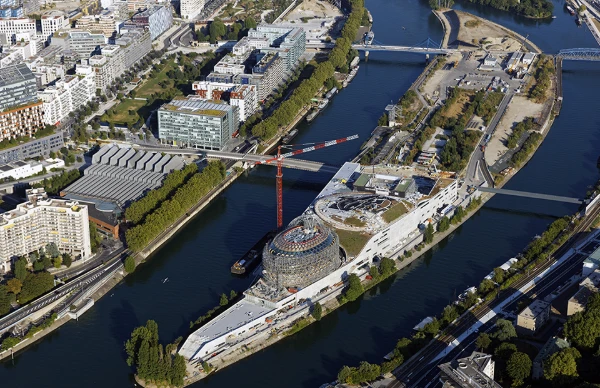
Île Seguin is one of the most striking examples of urban change in Greater Paris. Set in the Seine at Boulogne-Billancourt, immediately west of the French capital, the island spent much of the twentieth century behind the walls of Renault’s vast car factory. That industrial complex disappeared after production ended in 1992, leaving an unusually large riverside site whose future was debated for years. By 2026, the picture is very different. La Seine Musicale is an established concert destination, a new public park has opened across the centre of the island, contemporary sculptures line the landscape and the Pointe des Arts development is bringing galleries, cinema, restaurants and other public uses to the eastern end. The transformation is still unfolding, but visitors can already walk through a place where industrial history, architecture, music, art and the Seine now meet within a single district.
From Renault Factory Island to a Cultural District
Île Seguin’s modern identity was shaped above all by Renault. Louis Renault began acquiring land on the island in 1919, at a time when the company’s workshops were already expanding through neighbouring Billancourt. Construction of the island factory followed during the 1920s. The plant was inaugurated in November 1929, vehicle production began around this period, and the complex was fully completed in 1937. Eventually, the buildings occupied almost the whole of the island’s 11.5 hectares. Seen from the river, the enormous multi-storey structure was often compared with an ocean liner, an image that became inseparable from the industrial landscape of western Paris.
This was much more than a building where cars were assembled. Renault produced passenger vehicles, vans, buses, lorries and other equipment here, while the factory became an important workplace for generations of employees from France and abroad. At its busiest, around 10,000 people worked on the island. Models associated with Renault’s post-war expansion, including the 4CV and Renault 4, formed part of the history of the Billancourt works. Île Seguin also held an important place in French labour history. Industrial disputes and the social movements of the twentieth century made the factory a nationally recognised symbol of factory life, organised labour and the changing relationship between employers and workers.
By the late twentieth century, however, an island factory built for an earlier age of manufacturing had become increasingly difficult to adapt to modern production. Renault announced the closure in 1989, and the last vehicles left the production lines on 31 March 1992. The buildings were later demolished, principally in 2004 and 2005. The disappearance of such a large industrial complex created an exceptional opportunity, but also a difficult planning question: what should replace a factory that had dominated both the physical landscape and the collective memory of Boulogne-Billancourt for decades? A long succession of cultural, architectural and commercial proposals followed before the present direction gradually took shape.
How the Renault Heritage Can Still Be Seen
A visitor arriving in 2026 should not expect to find a preserved Renault production hall. The vast factory that once covered the island is gone, and the new buildings deliberately give Île Seguin a different function. Nevertheless, its industrial past remains central to understanding the site. The shape of the island, its relationship with the Seine and its connection to the surrounding former Renault land all make more sense when seen as parts of one enormous industrial estate. Across the neighbouring Trapèze district, former factory land has also been redeveloped, so the transformation extends well beyond the island itself.
The Pavillon des Projets in Boulogne-Billancourt is particularly useful for anyone who wants the historical context before walking around Île Seguin. Its permanent displays explain the former Renault factories and the subsequent redevelopment of the Île Seguin–Rives de Seine district. The centre also hosts exhibitions, talks and guided visits concerned with architecture, industrial heritage and recent urban change. It provides the background that is difficult to understand simply by looking at the new buildings, especially because so little of the immense factory structure survives on the island itself.
Another way to connect the new district with its previous life is the local “Voyage en industries” heritage route. It links locations associated with the industrial history of Boulogne-Billancourt and helps explain how Renault, aviation workshops and other businesses shaped this part of the Seine. Historical photographs and stories are especially valuable on Île Seguin because the contrast is so pronounced: places once occupied by assembly lines, workshops and thousands of employees are now used for concerts, walks, gardens and contemporary art. Rather than recreating the factory, the district uses interpretation and public art to keep its history visible while giving the land a completely different role.
What Visitors Can See on Île Seguin in 2026
The most established cultural landmark is La Seine Musicale at the western end of the island. Opened in April 2017, the complex was designed by Japanese architect Shigeru Ban with Jean de Gastines and is owned by the Département des Hauts-de-Seine. Its most recognisable feature is the rounded auditorium accompanied by a large moving solar sail. Inside, the building contains the Auditorium and the larger Grande Seine performance space, allowing it to host classical music, contemporary concerts, dance, festivals and large productions. The programme changes throughout the year, so visitors planning to attend a performance should check the current calendar rather than assuming that the building operates like a museum with continuous admission.
The island changed again at the beginning of 2026 with the opening of Parc départemental Gauthier-Mougin. The 1.6-hectare park was officially opened to the public on 31 January and occupies a central position between the cultural developments at the two ends of Île Seguin. Designed by landscape architect Michel Desvigne, it includes meadows, wooded areas, redesigned riverbanks, walking routes and more than 800 newly planted trees. This matters for visitors because Île Seguin is no longer experienced only as a series of large buildings. The landscaped centre creates a genuine public walk beside the Seine and makes it possible to spend time on the island without attending a ticketed event.
The eastern end is undergoing its most visible change in 2026 through Pointe des Arts. This mixed cultural district includes the new Large art centre, a Pathé cinema complex, landscaped public areas, restaurants, shops, offices and a hotel development. The eight-screen Pathé Île Seguin, including an IMAX auditorium, began operating on 15 July 2026. Large, the new contemporary art centre, is scheduled to welcome visitors from 17 October 2026 with its inaugural exhibition, “Moteur Imaginaire”, linking works from the Renault Collection with contemporary artists. As a result, someone visiting early in 2026 and someone arriving towards the end of the year may encounter noticeably different levels of activity at the eastern end of the island.
La Seine Musicale, Public Art and the New Riverside Landscape
La Seine Musicale is worth seeing even when there is no concert in a visitor’s itinerary. Its position at the tip of the island makes the building highly visible from Pont de Sèvres and from both banks of the Seine. Shigeru Ban and Jean de Gastines designed its curved form in response to the narrow riverside site, while the timber structure around the auditorium and the large photovoltaic sail create a distinctive silhouette. The building also contains public circulation areas and is integrated with outdoor spaces rather than functioning as an isolated concert hall behind closed doors.
The new park changes the character of a walk from La Seine Musicale towards Pointe des Arts. Gauthier-Mougin was conceived not simply as green decoration but as part of a wider art route. Around twenty sculptures are distributed between Pointe des Arts, the departmental park and the surroundings of La Seine Musicale, using works from public and private collections. The result is an open-air cultural route where visitors encounter art while moving through the landscape rather than entering a conventional gallery. Trees, sloping lawns and views over the Seine soften a site once almost entirely covered by industrial buildings.
Pointe des Arts adds another architectural layer. Its principal cultural buildings were designed by RCR Arquitectes, the Catalan practice that received the Pritzker Architecture Prize in 2017, working with CALQ. The intention is to connect buildings, gardens and the river through public routes rather than treating the eastern tip as a closed private development. For travellers, the most useful point is that Île Seguin should now be thought of as a district with several different attractions. A concert at La Seine Musicale, an exhibition at Large, a cinema visit, public sculpture and a walk beside the Seine can all form part of the same trip, but opening times and individual admission arrangements still vary between venues.
How to Visit Île Seguin in 2026
Although Île Seguin is often described in travel writing as being in Paris, it is administratively in Boulogne-Billancourt in the Hauts-de-Seine department, directly beside the capital’s western edge. For most tourists staying in central Paris, the simplest public-transport route is Métro Line 9 to Pont de Sèvres, its western terminus. From the station, signs lead towards the Seine and the pedestrian connection to La Seine Musicale. This makes the island practical as a half-day excursion without needing a car, particularly for travellers already visiting western Paris, the Bois de Boulogne or other sites around Boulogne-Billancourt.
Walking is the best way to understand the island once there. Starting around Pont de Sèvres brings visitors directly towards La Seine Musicale at the western end. From there, the route can continue through the landscaped areas and Parc Gauthier-Mougin towards Pointe des Arts. Distances are manageable, but it is worth allowing time to stop beside the river and look back towards Boulogne-Billancourt and across to Meudon. The redevelopment was designed around pedestrian movement and public space, so moving slowly across the island reveals more than travelling directly from one building to another.
Visitors should also remember that Île Seguin in 2026 is both an attraction and an active redevelopment area. La Seine Musicale has been operating for years, the departmental park is open and the Pathé cinema is already receiving visitors, while other parts of Pointe des Arts are entering service in stages during the autumn. Large is due to open on 17 October 2026, meaning information about access, restaurants, exhibitions and individual buildings can change as the new district settles into everyday operation. Checking the official pages of the venue concerned shortly before travelling is therefore sensible, especially when the main purpose of a visit is a concert, exhibition or cinema screening.
Planning a Half-Day or Full-Day Visit
A practical half-day visit can begin at Pont de Sèvres and focus on the island itself. After crossing towards La Seine Musicale, spend some time viewing the architecture and the riverside setting before continuing through Parc Gauthier-Mougin. The public art along the route gives the walk a clear cultural theme without requiring a ticket. Continue towards Pointe des Arts to see the newest part of the transformation. From 17 October 2026, the opening of Large makes it possible to add a contemporary art exhibition, while the Pathé cinema offers another indoor option throughout the day.
For a fuller understanding of the area, allow most of a day and include the surrounding former Renault district in Boulogne-Billancourt. Beginning at the Pavillon des Projets provides useful historical orientation before visiting the island. From there, sections of the industrial heritage route help establish the scale of Renault’s former presence before the walk continues towards the Seine. This order works particularly well for first-time visitors because the new landscape becomes easier to read once the history of the factory, its workers and the wider Billancourt industrial estate is understood.
What makes Île Seguin particularly interesting in 2026 is not a single monument but the contrast between successive periods of its history. Within living memory, nearly the entire island was occupied by one of France’s best-known factories. Today the same stretch of land contains a major music venue, a new riverside park, contemporary sculpture, cinema and a growing arts district. The industrial buildings have largely disappeared, but the Renault story remains an essential part of the place. Île Seguin therefore offers something different from the historic centre of Paris: it shows how Greater Paris is reusing former industrial land while still negotiating how much of its past should remain visible in the city of the future.
Popular articles
-
 The history of the Kurhaus in Baden-Baden – the jewel of casinos...
A few centuries ago, gambling was closely associated with aristocratic …
-
Île Seguin in Paris in 2026: How a Former Renault Factory Became a New...
Île Seguin is one of the most striking examples of …
-
 Casino Admiral Škofije After Its 2026 Renovation: What to See on the S...
Casino & Hotel Admiral Škofije reopened on 3 April 2026 …