
Saint-Michel Tower in Bordeaux Reopens in 2026 After Major Restoration
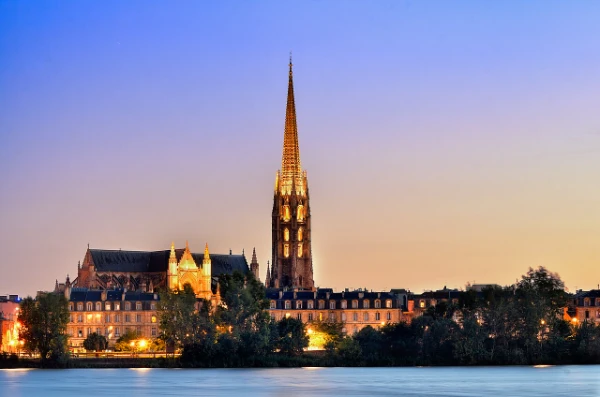
One of Bordeaux’s most recognisable historic landmarks welcomed visitors again on 13 June 2026, following almost five years of extensive restoration. The 114-metre Saint-Michel Tower, known locally as La Flèche Saint-Michel, had been closed to the public since November 2021 while specialists repaired its ageing stonework and reinforced vulnerable sections. Its reopening has restored access to one of the city’s most remarkable viewpoints and brought renewed attention to the historic Saint-Michel neighbourhood. Standing separately from the adjoining Gothic basilica, the tower offers an unusual combination of medieval architecture, centuries of local history and panoramic views across the Garonne. For tourists visiting Bordeaux in 2026, the restored monument provides an opportunity to see the city’s heritage from an entirely different perspective.
Saint-Michel Tower Returns to Bordeaux’s Tourist Attractions in 2026
The reopening of Saint-Michel Tower represents an important development for cultural tourism in Bordeaux. For nearly five years, the monument remained surrounded by enormous scaffolding, preventing visitors from climbing its historic staircase and obscuring much of its distinctive Gothic architecture. The restoration was completed in the first half of 2026, allowing the public to return on 13 June. At 114 metres, the tower is the tallest structure in Bordeaux and the fourth-tallest bell tower in France. Its return has restored a familiar feature of the city’s skyline while giving travellers another reason to spend time in the southern part of the historic centre.
The official reopening was accompanied by celebrations organised around Place Meynard, the square beside the basilica. The inauguration on 13 June coincided with the closing festivities of the Chahuts cultural festival and included a carillon performance and free evening concerts. Bordeaux also introduced a temporary free-admission period from 13 June to 5 July, giving local residents and visitors an opportunity to return to the monument. According to the official announcement, all 3,800 places offered for this introductory period were quickly taken. The strong initial demand illustrated the importance of the tower to local residents and the considerable interest surrounding its restoration.
The reopening has particular significance for the Saint-Michel district, an area characterised by independent shops, traditional markets, cafés and a culturally diverse community. Unlike some of Bordeaux’s more formal architectural squares, the neighbourhood has a lively atmosphere shaped by everyday local activity. The tower stands at the centre of this setting, connecting the district’s historical identity with its present-day life. Visitors can now combine a climb to the observation terrace with a walk around the basilica, nearby market streets and the riverfront. This makes Saint-Michel a worthwhile destination in its own right rather than simply another monument to photograph while passing through Bordeaux.
What the Five-Year Restoration Achieved
The latest renovation addressed problems that had developed over many decades. A detailed structural assessment carried out in 2011 identified deteriorating stonework, cracks in several parts of the tower and corrosion affecting the metal structure supporting the cross at its summit. Earlier repairs had not completely resolved these difficulties, making further conservation necessary. Work was organised into successive stages beginning in 2017, while the major programme associated with the recent closure continued from 2021 until 2026. The objective was not to redesign the monument but to preserve its historic appearance, strengthen weakened sections and reduce the risks associated with falling masonry.
One of the most striking aspects of the project was the enormous scaffolding erected around the tower. Weighing approximately 700 tonnes, the temporary structure allowed conservation specialists to reach areas that would otherwise have been extremely difficult to access. Particular attention was given to the upper section between 62 and 114 metres, where damaged masonry and structural weaknesses required careful treatment. Restoration of the section between 46 and 62 metres was completed in December 2025. During the first five months of 2026, workers progressively dismantled the scaffolding and restored the surrounding public space, revealing the tower’s architectural details again after years of construction activity.
The project involved several public authorities, including the City of Bordeaux, the French Ministry of Culture and the Nouvelle-Aquitaine regional administration. Michel Goutal, chief architect for historic monuments, supervised the architectural work, while heritage specialists monitored the conservation process. A joint press statement issued for the reopening reported an overall investment of €11.3 million, covering contributions from the city, the French state and the region. Beyond the financial investment, the work required specialist knowledge of historic stone structures and traditional building methods. The result is a monument that retains its familiar appearance while benefiting from essential repairs intended to support its long-term preservation.
History and Architecture of Bordeaux’s 114-Metre Bell Tower
Saint-Michel Tower has been part of Bordeaux’s architectural identity for more than five centuries. Construction took place between 1472 and 1492, during a period when the city was developing its importance as a commercial and religious centre. The tower was blessed on 29 September 1492, the feast day of Saint Michael. Its exceptional height reflected the ambitions of the parish and the prosperity associated with medieval Bordeaux. Designed in the Flamboyant Gothic tradition, the building is distinguished by its slender proportions, pointed arches and elaborate stone decoration. These features create a striking vertical silhouette visible from many streets and open spaces across the city.
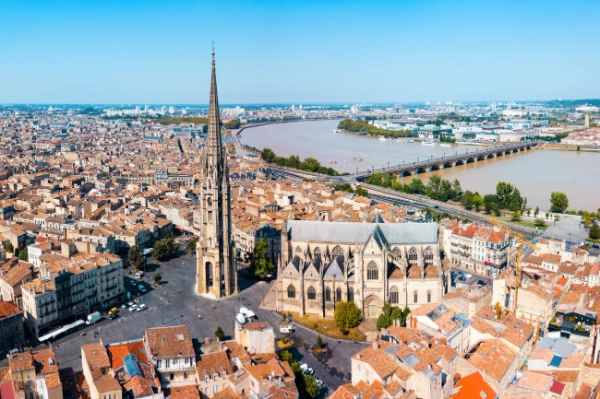
One of the building’s most unusual characteristics is its position approximately 20 metres from the Basilica of Saint-Michel rather than directly above the church. This arrangement is known as a separate bell tower or campanile. Bordeaux Cathedral has a comparable architectural feature in the form of the Pey-Berland Tower. Separating a bell tower from the main religious building helped limit the effects of vibrations produced by large bells. At Saint-Michel, this practical decision also created a distinctive architectural composition. The basilica extends horizontally across the square, while the independent tower rises sharply above the surrounding rooftops, making both buildings particularly recognisable.
The history of Saint-Michel Tower also reflects the difficulties involved in preserving a monument exposed to centuries of changing weather. The building experienced an earthquake in 1759, and a violent storm in 1768 destroyed much of its upper spire. During the nineteenth century, architect Paul Abadie directed an important restoration campaign that reconstructed the damaged upper section and returned the tower to its characteristic pointed profile. The basilica and bell tower had already received protection as French historic monuments in 1846. In 1998, the religious complex gained further international recognition through its inclusion in the UNESCO World Heritage listing for the Routes of Santiago de Compostela in France.
The Medieval Heritage and Lesser-Known Stories of Saint-Michel
The tower’s history extends beyond its architecture. Beneath the building lies a crypt associated with an earlier funerary chapel that occupied the site before the present bell tower was constructed. This underground space later became famous for the naturally preserved human remains discovered during changes to the former parish cemetery. In 1791, a collection of bodies known as the Saint-Michel mummies began attracting considerable public interest. They remained an unusual part of Bordeaux’s local heritage for generations. Although the crypt’s historical associations are well documented, visitors should not assume that the former mummy exhibition remains available as part of the modern tower visit.
Another distinctive feature is the tower’s historic carillon, consisting of 22 bells dating from the nineteenth century. These bells continue to contribute to the soundscape of the Saint-Michel neighbourhood. According to the monument’s visitor information, they mark the hours and quarter-hours between 9 am and 8 pm, with additional short melodies at 12.30 pm and 6.45 pm. In earlier centuries, bells served purposes extending well beyond religious worship, including signalling public events, celebrations and emergencies. Their continued use provides an audible connection between the present-day district and the everyday routines of previous generations.
Saint-Michel’s location also helps explain its importance to Bordeaux’s development. The surrounding quarter grew close to the Garonne, where river commerce, workshops and trading activities contributed to the city’s prosperity. Its religious buildings served a population connected with both local communities and wider commercial networks. Today, the basilica and tower form part of an urban landscape in which medieval structures stand near later stone façades and bustling public spaces. For visitors interested in understanding Bordeaux beyond its grand eighteenth-century architecture, Saint-Michel offers a more varied picture of the city’s history, bringing together religious heritage, neighbourhood traditions and the long influence of the river.
Visiting Saint-Michel Tower in 2026: Tickets, Opening Hours and Views
Saint-Michel Tower is located at 16 Place Meynard, 33000 Bordeaux, within walking distance of the Garonne and the historic city centre. Following its reopening, the monument operates a seasonal visiting schedule from April to October. The published opening hours are 10 am to 1 pm and 2 pm to 6 pm daily, with admission ending 30 minutes before closing. Standard adult admission costs €7, while the reduced rate is €5. A special €2 rate is available to eligible Carte Jeune holders, and accompanied children under 13 can enter free of charge. Visitors holding a valid Bordeaux CityPass are also entitled to free admission under the published conditions.
Tickets can be purchased through the monument’s official website or at the entrance, subject to availability. Advance booking is not generally required, but capacity is limited to 19 people at a time for safety reasons, so visitors may have to wait during busy periods. The published conditions also provide free admission on the first Sunday of the month, except in July and August. Payment at the monument is by bank card rather than cash. Travellers planning a visit should consult the official website at www.fleche-saint-michel.com before setting out, particularly when travelling outside the principal tourist season or around public holidays, as opening arrangements and admission conditions may change.
The main attraction is the observation terrace, reached by climbing 230 steps through the tower’s historic interior. Although the structure rises to 114 metres, the public viewing level is approximately 47 metres above the ground. This distinction is important for visitors expecting to reach the very top of the spire. The climb passes through three levels and involves narrow staircases, making comfortable footwear advisable. There is no lift, and the site is not accessible to wheelchair users or people unable to manage a substantial staircase. The monument also has no secure lockers for belongings, so travelling with a small bag is preferable to carrying large or heavy items.
Panoramic Views and Nearby Attractions Worth Visiting
From the observation terrace, visitors can appreciate Bordeaux’s historic layout and the broad curve of the Garonne that gives the city its familiar Port of the Moon identity. The view includes closely packed rooftops, church towers, the riverfront and the Pont de Pierre, the nineteenth-century stone bridge connecting the two banks. On clear days, the raised landscape on the eastern side of the river is also visible. Looking northwards, visitors can identify important areas of the historic centre and understand how Bordeaux’s principal streets and monuments relate to the river. The restored tower is especially appealing to photographers because its elevated position provides perspectives that are difficult to obtain at street level.
After descending, the surrounding neighbourhood offers several worthwhile additions to a walking itinerary. The Basilica of Saint-Michel stands immediately beside the tower, making it a natural first stop for anyone interested in Gothic architecture. Nearby streets lead towards the Marché des Capucins, one of Bordeaux’s best-known food markets, where local produce and regional specialities reflect the city’s culinary traditions. A walk towards the river brings visitors to the Quai des Salinières and the Pont de Pierre, with attractive views back towards the bell tower. Those continuing north along the waterfront can reach the historic centre, including Place de la Bourse and the Miroir d’Eau.
Visitors interested in seeing more of Bordeaux’s historic towers can also consider the combined Saint-Michel Tower and Porte Cailhau ticket. The official visitor service lists a standard combined price of €11, compared with €14 for two separate admissions, with a reduced combined rate also available. Porte Cailhau provides a different perspective on medieval Bordeaux through its former defensive gateway and richly decorated architecture. Together, the two monuments make a rewarding historical itinerary without requiring a full day. The reopening of Saint-Michel Tower in 2026 has therefore restored more than an individual attraction: it has returned an important viewpoint, a familiar neighbourhood landmark and a valuable connection to Bordeaux’s architectural past.
Popular articles
-
Saint-Michel Tower in Bordeaux Reopens in 2026 After Major Restoration
One of Bordeaux’s most recognisable historic landmarks welcomed visitors again …
-
 The multifaceted City of Ho Chi Minh City
Ho Chi Minh City, formerly known as Saigon, is visited …
-
 The history of the Kurhaus in Baden-Baden – the jewel of casinos...
A few centuries ago, gambling was closely associated with aristocratic …