
Granada Without Haste: The Alhambra, Albaicín and Andalusian Life
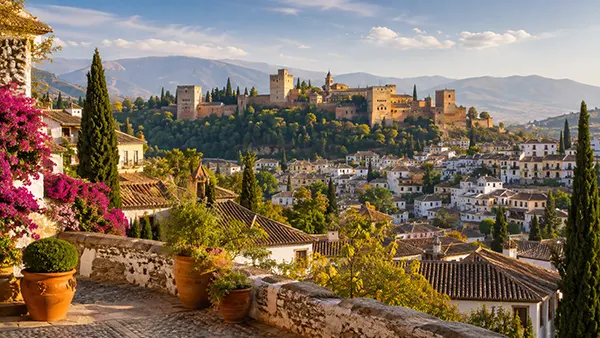
Granada rewards travellers who resist the urge to treat it as a sequence of famous sights. The city is shaped by two historic hills, the Alhambra and the Albaicín, with the Darro valley between them and the modern centre spreading below. A well-paced visit leaves room for the Nasrid palaces, shaded gardens, steep residential lanes, late lunches and quiet pauses in small squares. Three days are enough to understand the basic geography without rushing, while a fourth day makes space for Sacromonte, the Realejo or a short trip beyond the centre. The practical details matter: Alhambra admission is timed, the Albaicín is physically demanding, and Granada’s summer heat can alter even a carefully prepared route. The aim is not to see everything, but to arrange each day so that the city’s history, everyday habits and changing light remain connected rather than becoming isolated photographs.
Give the Alhambra the Time It Deserves
The Alhambra is not a single palace but a fortified hilltop complex formed over several centuries. Its main visitor areas are the Alcazaba, the Nasrid Palaces, the Partal and the Generalife, each with a different character. The Alcazaba is the military core, with towers that place Granada’s plain and the Albaicín into geographical context. The Nasrid Palaces are more intimate, organised around courtyards, water channels, carved plaster, timber ceilings and carefully controlled views. The Partal connects architecture with terraces and gardens, while the Generalife served as a country residence with cultivated land and water at the centre of its design. UNESCO treats the Alhambra, Generalife and Albaicín as a connected heritage site because the palace city and residential quarter represent complementary parts of medieval Granada. Seeing that relationship is easier when the visit is allowed to unfold over half a day rather than being compressed into a short guided circuit.
Planning begins with the official ticket, because entry to the Nasrid Palaces is fixed to the time printed on it. Missing that slot normally means losing access to the palaces, even when the rest of the complex remains open. In 2026, the standard Alhambra General ticket is listed at €22.27 before the online service charge, and strong demand makes advance purchase sensible throughout the year. Tickets are personal, so every visitor should carry the original passport or identity document used for the booking, together with the QR code in digital or printed form. The official guidance estimates about three hours for the principal route, but four hours is more realistic for travellers who stop to read, sit in the gardens or take photographs. Daytime opening normally runs from 08:30 to 20:00 between 1 April and 14 October, and from 08:30 to 18:00 during the cooler part of the year, though hours and temporary restrictions should be checked shortly before the visit.
A calm route is built around the Nasrid Palace appointment rather than around a rigid order copied from another traveller. An early palace slot works well for people who prefer quieter rooms and softer morning light; a later slot allows time to begin with the Alcazaba and understand the defensive structure before entering the royal spaces. Inside the palaces, slow down at the Court of the Myrtles, the Hall of the Ambassadors and the Court of the Lions. The decoration is dense, but the effect depends just as much on proportion, shadow, sound and the reflection of water. Continue through the Partal at an easier pace, then leave enough energy for the Generalife, which involves further walking and changes of level. The gardens are not merely a decorative ending: their channels, courtyards and planted terraces show how water, cultivation and leisure were integrated into the wider estate. A short pause there often gives more context than another hurried room.
How to Plan an Unhurried Visit
There are several practical ways to reach the Alhambra, and the best choice depends on heat, mobility and the rest of the day. The most atmospheric approach begins near Plaza Nueva and climbs through the Puerta de las Granadas along the wooded Cuesta de Gomérez. It is attractive but consistently uphill, so it should not be treated as an effortless stroll. The C30 bus links the city centre with the Alhambra and is a sensible option in hot weather or before a long visit. The C32 connects the Alhambra with the Albaicín, making it useful for travellers who want to move between the two historic hills without returning to the lower centre. A taxi can save energy, especially for an early timed entry, but traffic controls mean that drivers follow designated access routes. Arriving at least thirty minutes before the palace slot leaves time for security, orientation and the walk from the entrance area to the Nasrid Palaces.
Comfortable footwear is more important than formal clothing because the route includes cobbles, smooth stone, stairs and stretches of bare ground. Carry water, sun protection and a light layer outside summer, when the hill can feel cooler than the centre in the morning. Large luggage has no place on this itinerary, and the current rules do not allow backpacks larger than 40 by 40 centimetres. Selfie sticks, tripods and flash photography are prohibited in the Nasrid Palaces, while food and drink are limited to authorised areas outside the main visitor route. These rules are easier to manage when possessions are kept simple. Travellers with reduced mobility should consult the official accessibility information before booking, as the historic surfaces and level changes make some sections difficult. Families should also note that pushchairs cannot enter the Nasrid Palaces, the Generalife Palace or the Alcazaba and must be left in the designated storage area.
Do not schedule another major monument immediately after the Alhambra. The visit requires concentration as well as walking, and the details begin to blur when the next reservation is too close. After leaving, choose one gentle continuation: descend through the Alhambra woods towards Plaza Nueva, take a bus back to the centre for lunch, or use the C32 towards the Albaicín and stop before attempting another long climb. A midday visit in summer is physically harder, so an early morning slot followed by lunch and rest is usually more comfortable. In winter, the shorter opening day makes an earlier start useful, while clear cold weather can produce exceptionally sharp views of the Sierra Nevada. Evening tickets offer a different reading of the palaces, but they cover selected areas and should not be assumed to replace the complete daytime route. The least tiring plan is the one that leaves a margin around the fixed admission time.
Walk Through the Albaicín Rather Than Across It
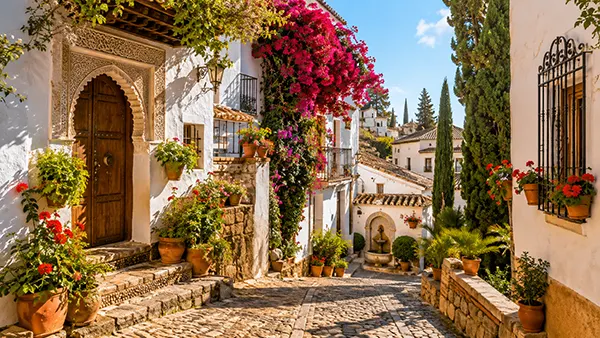
The Albaicín is often approached as the place from which to photograph the Alhambra, yet it is first of all a lived-in historic district. Its medieval street pattern survives in narrow lanes, sudden turns, small squares and routes that follow the contours of the hill rather than a modern grid. White walls conceal carmens, the Granadan term for houses with enclosed gardens or orchards, while church towers, surviving gates, water cisterns and former Andalusi buildings show how the district changed after the Christian conquest. The neighbourhood was added to Granada’s UNESCO designation in 1994, ten years after the Alhambra and Generalife were inscribed. Its importance lies not in one dominant monument but in the relationship between urban form, domestic architecture and everyday use. Walking without constant reference to the fastest map route makes that structure easier to read, though a downloaded map remains useful when lanes divide unexpectedly or mobile coverage weakens.
A coherent first walk begins at Plaza Nueva, follows Carrera del Darro beside the river and continues towards Paseo de los Tristes. This lower section introduces the visual link between the two hills without demanding an immediate climb. The Bañuelo, an eleventh-century bathhouse, sits close to the route and gives valuable context for domestic life, water and hygiene in medieval Granada. From Paseo de los Tristes, Cuesta del Chapiz rises towards the higher Albaicín and Sacromonte. The slope is serious, so pauses should be treated as part of the route rather than as delays. Near the top, Plaza Larga provides a useful break among local shops, cafés and residents carrying out ordinary errands. From there, the lanes towards the Mirador de San Nicolás pass whitewashed houses and small squares before opening onto the best-known view of the Alhambra. Completing this route slowly can take most of a morning, especially with a monument visit or long lunch.
The district becomes more rewarding when the main route is balanced with one or two quieter interiors. The Palacio de Dar al-Horra preserves a Nasrid residence associated with Aixa, the mother of Boabdil, and its courtyard offers a smaller-scale counterpart to the Alhambra. Casa de Zafra helps explain the structure of a Moorish house, while the Bañuelo, Casa Horno de Oro and the Maristán belong to the group of Andalusi monuments managed alongside the Alhambra. Current opening times vary by season, with a split schedule during the warmer months for several sites, so it is better to confirm one chosen stop than to build the whole day around an ambitious sequence. Churches such as San Nicolás and San Salvador also reflect the reuse and transformation of earlier religious spaces. The value of these places is cumulative: each adds a modest piece to the history of the neighbourhood without requiring the intensity of another large monument.
Viewpoints, Courtyards and Daily Life
The Mirador de San Nicolás is famous for good reason: the Alhambra sits directly across the valley, with the Sierra Nevada behind it when visibility is clear. Sunset, however, is also the busiest period, and the square can feel more like an event space than a neighbourhood viewpoint. Early morning is calmer, while the hour before sunset often provides warm light without requiring a last-minute struggle for space. Nearby alternatives offer different angles rather than an inferior version of the same scene. Placeta de Carvajales looks towards the Alhambra from a lower and more intimate position, while the Mirador de San Cristóbal opens towards the city walls and northern districts. No viewpoint is guaranteed to be quiet, particularly at weekends and during holidays. A flexible route allows the light, weather and crowd level to determine where to stop instead of treating one photograph as a compulsory task.
Respect for residents is essential because many attractive doors, courtyards and terraces belong to private homes. The narrow lanes amplify noise, and groups can block access more easily than they realise. Keep voices low at night, avoid sitting on private steps, and do not photograph through open windows or gates. Cars, delivery vehicles and local buses still use streets that appear pedestrian at first glance, so attention is needed on blind corners. The same restraint applies to carmens that operate as restaurants, museums or accommodation: their gardens are part of a long local tradition, not generic decorative sets. Supporting small businesses can be valuable, but quality varies, and a view does not automatically justify a high price. Reading recent menus, checking opening days and choosing places that explain what they serve usually leads to a better meal than following the busiest terrace.
Food provides a natural pause between steep sections. Many Granada bars still serve a small tapa with a paid drink, although the portion, choice and conditions differ from one establishment to another. In and around the Albaicín, menus may include habas con jamón, aubergines with cane honey, remojón granadino made with orange and salted cod, or hearty stews suited to cooler weather. Tortilla del Sacromonte is a traditional local dish made with offal and is worth ordering only after understanding its ingredients. Tea rooms around Calle Calderería Nueva reflect the city’s modern North African connections as well as its tourism economy; some are calm places for mint tea, while others are designed for rapid turnover. For something sweet, piononos from nearby Santa Fe are widely sold in Granada. A long lunch followed by coffee is often more consistent with the neighbourhood’s rhythm than trying to fit several viewpoints into the hottest part of the afternoon.
Let Granada Set the Pace
The lower city gives the two historic hills their wider setting and deserves at least one unhurried day. Around the Cathedral and Royal Chapel, monumental Christian Granada stands close to the former commercial lanes of the Alcaicería and the surviving courtyard of the Corral del Carbón. The Royal Chapel contains the tombs of Isabella I of Castile and Ferdinand II of Aragon, making it central to the political history that followed the conquest of Granada in 1492. Yet the centre is not only a collection of formal buildings. Plaza Bib-Rambla, the streets around the market and the route towards Puerta Real show the active commercial city in which residents shop, meet and work. South-east of the centre, the Realejo offers a different atmosphere, with sloping streets, Campo del Príncipe, traditional houses and contemporary murals. Moving between these areas on foot helps explain how Granada grew around, below and beyond the medieval hills.
Granada’s daily timetable can feel late to visitors from northern Europe, but it should not be reduced to a simple stereotype about siestas. Museums and monuments follow published hours, while independent shops may close in the afternoon or operate a split day. Lunch commonly begins after 13:30, and dinner service often becomes livelier after 20:30, though central restaurants serving visitors open earlier. Checking hours on the day prevents long waits, particularly on Sundays, public holidays and during August. The most comfortable approach is to use mornings for uphill walks or major sights, take a proper lunch, and reserve the late afternoon for a museum, café or shaded route. Evening then becomes useful for a short paseo, tapas or a performance. This pattern is not only cultural; it is practical in a city where summer temperatures and steep streets can make continuous sightseeing unpleasant.
Season strongly affects the experience. Spring brings mild walking weather and flowering gardens but also busy holiday periods, particularly around Easter. Early autumn often combines warm days with more manageable evenings, while late autumn and winter can be cold after sunset because Granada stands well above sea level. Snow on the Sierra Nevada may be visible from the city even when central streets are dry. July and August require the greatest care: shade, water, early starts and a lighter afternoon are more useful than an overloaded itinerary. Three nights provide a sensible minimum for the Alhambra, the Albaicín and the centre. A fourth allows time for Sacromonte, the Science Park, the Monastery of La Cartuja or a day trip without sacrificing rest. The right length is the one that leaves space for ordinary meals and unscheduled walks, since these often provide the clearest sense of Granada as a functioning Andalusian city.
A Balanced Three-Day Stay
On the first day, begin in the lower centre so that the city’s layout becomes familiar before the hills. Visit the Cathedral and Royal Chapel in the morning, then walk through the Alcaicería to the Corral del Carbón and continue towards Plaza Nueva. After lunch, cross into the Realejo for Campo del Príncipe, the exterior of Santo Domingo and the streets beneath the Alhambra. This arrangement avoids a demanding climb immediately after arrival and creates a useful visual framework for the next two days. In the evening, return to the centre for a short tapas route rather than committing to a formal programme. One or two bars are enough to understand how the local custom works, and ordering gradually gives more control over both appetite and cost. An early night is worthwhile when the Alhambra ticket is scheduled for the following morning.
Devote the second day to the Alhambra and protect the hours around the timed Nasrid Palace entry. Allow at least half a day for the Alcazaba, palaces, Partal and Generalife, with water and a short rest before leaving the complex. Lunch can follow in the centre or near the Realejo, depending on the exit route and energy level. Keep the afternoon deliberately light: a hammam-style bath, the Alhambra Museum in the Palace of Charles V if timing permits, a café, or a slow walk beside the Darro all work better than another large sight. A flamenco performance can fit in the evening, but venue choice deserves care. Sacromonte’s zambra tradition is historically associated with the local Roma community, while shows elsewhere range from serious small-scale performances to short tourist programmes. Transparent running times, named performers and clear seating arrangements are useful signs when comparing options.
Use the third day for the Albaicín, starting early at Carrera del Darro and climbing gradually through Cuesta del Chapiz towards Plaza Larga and San Nicolás. Choose one Andalusi monument or historic house rather than attempting every ticketed interior, then stop for lunch before the warmest or busiest part of the day. Continue to Sacromonte only when energy and weather allow; the C34 bus links the area with the centre, while the C31 serves the Albaicín and the C32 connects the Albaicín with the Alhambra. Leave the final hours open for a second viewpoint, tea, shopping from local makers or simply returning to a street that seemed interesting earlier. This final margin is what turns the itinerary from a checklist into a coherent stay. Granada’s strongest impression comes from the relationship between palace, neighbourhood, landscape and daily routine, and that relationship becomes clearer when there is enough time to notice how each part changes across the day.
Popular articles
-
 The history of the Kurhaus in Baden-Baden – the jewel of casinos...
A few centuries ago, gambling was closely associated with aristocratic …
-
 Île Seguin in Paris in 2026: How a Former Renault Factory Became a New...
Île Seguin is one of the most striking examples of …
-
 Casino Admiral Škofije After Its 2026 Renovation: What to See on the S...
Casino & Hotel Admiral Škofije reopened on 3 April 2026 …