
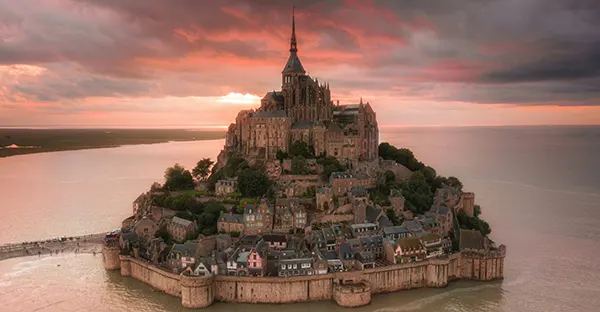
Mont-Saint-Michel (France): the abbey island shaped by tides
Mont-Saint-Michel is one of the most distinctive historical sites in France, located off the coast of Normandy where land, sea, and architecture meet in constant motion. Rising from a tidal bay, the island has functioned over centuries as a place of worship, defence, pilgrimage, and settlement. Its character is defined not only by its medieval abbey but also by the extreme tidal changes that regularly transform it from an island into a peninsula and back again.
The geographical setting and tidal phenomenon
The bay of Mont-Saint-Michel is known for having some of the strongest tidal variations in continental Europe. Depending on the lunar cycle and weather conditions, the sea can retreat several kilometres, exposing vast mudflats before returning rapidly. This natural rhythm has shaped both the landscape and the human use of the area for more than a thousand years.
At low tide, Mont-Saint-Michel appears connected to the mainland by wide expanses of sand and silt. At high tide, water surrounds the rocky outcrop entirely, restoring its island status. Since 2015, a redesigned causeway has allowed tidal waters to flow freely again, reversing decades of sediment buildup caused by earlier road construction.
The bay itself is protected as an important natural environment, hosting migratory birds and unique coastal ecosystems. Visitors today experience a carefully managed balance between tourism access and environmental preservation.
Risks and navigation in the bay
Despite its open appearance, the bay can be dangerous without proper knowledge. The ground consists of unstable sediments where sudden sinkholes may form, and the tide can advance faster than expected. Historically, these conditions served as a natural defence against attackers.
Modern safety measures include guided crossings led by licensed local guides who understand the terrain, tidal schedules, and weather patterns. These walks provide insight into the bay’s geology while ensuring safe passage.
Unsupervised crossings are discouraged, as tidal charts alone do not account for shifting sands or wind-driven surges. Respect for local regulations remains essential for both safety and conservation.
The history of the abbey and settlement
The origins of Mont-Saint-Michel date back to the early 8th century when a sanctuary dedicated to Saint Michael the Archangel was established on the rock. Over time, this modest structure evolved into a major Benedictine abbey, drawing pilgrims from across Europe.
Construction continued across several centuries, resulting in a complex architectural ensemble combining Romanesque foundations with Gothic verticality. The abbey’s upper levels were designed to maximise limited space, giving rise to the dramatic silhouette visible today.
Beyond its religious role, Mont-Saint-Michel functioned as a fortified stronghold. During the Hundred Years’ War, it resisted English sieges, reinforcing its symbolic importance within French history.
From monastery to prison and heritage site
Following the French Revolution, the abbey was secularised and repurposed as a state prison. Its remote location and thick walls made it suitable for detention, though this period caused significant structural damage.
In the 19th century, growing awareness of its historical value led to restoration efforts. The prison was closed, and the site gradually regained its cultural significance through preservation campaigns.
Today, Mont-Saint-Michel is recognised as a UNESCO World Heritage Site, valued for both its architectural achievement and its historical continuity.

Visiting Mont-Saint-Michel in the present day
Access to Mont-Saint-Michel is now carefully regulated to manage visitor flow and protect the site. Shuttle services, pedestrian routes, and limited vehicle access reduce environmental strain while maintaining practical connectivity.
Inside the island, narrow streets lead upward through historic houses, museums, and small shops toward the abbey at the summit. These paths reflect medieval urban planning adapted to extreme spatial constraints.
Seasonal variations influence the visitor experience, with spring and autumn offering quieter conditions compared to peak summer months. Tide schedules also affect visual impressions and photography opportunities.
Practical considerations for travellers
Comfortable footwear is essential due to steep gradients and uneven stone surfaces. Weather conditions can change quickly, particularly winds coming off the bay.
Advance booking is recommended for abbey entry, especially during holidays. Guided tours provide historical context that enhances understanding of the site’s layered past.
Respect for heritage rules, including restricted areas and conservation measures, ensures that Mont-Saint-Michel remains preserved for future generations.
Popular articles
-
 Plitvice Lakes, Croatia: When to Visit for the Best Experience
Plitvice Lakes National Park is one of Croatia’s most recognised …
-
 Salzburg (Austria): Old Town, Fortress and Scenic Panoramas — A Weeken...
Salzburg is one of the most compact historic cities in …
-
 Meteora, Greece: Monasteries, Dress Code and a One-Day Route
Meteora is one of the most extraordinary cultural landscapes in …