
Depression Danakil: Ethiopia’s Fierce and Haunting Landscape
The Danakil Depression in Ethiopia is often described as one of the most extreme places on Earth. Its volcanic craters, acidic pools and blistering temperatures create a landscape shaped by forces that never seem to rest. Despite its harsh nature, it remains an area of extraordinary geological importance, drawing researchers who look to understand how the planet behaves in conditions close to those of early Earth.
Geological Origins of the Danakil Depression
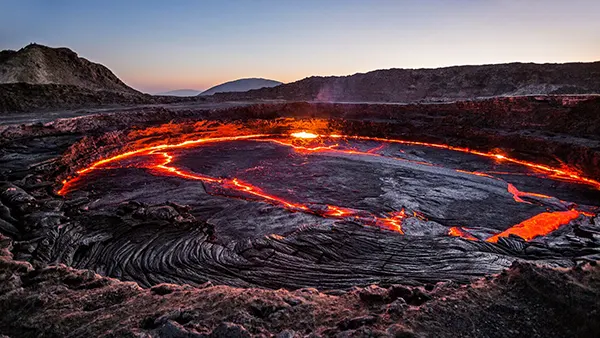
The Danakil Depression sits at the meeting point of three tectonic plates: the African, Somali and Arabian plates. Their slow divergence continuously stretches the crust, forming rifts and deep fractures. This process causes magma to rise to the surface, creating active volcanoes such as Erta Ale, which hosts one of the world’s few persistent lava lakes. The region’s dramatic subsidence has pushed parts of it more than 100 metres below sea level.
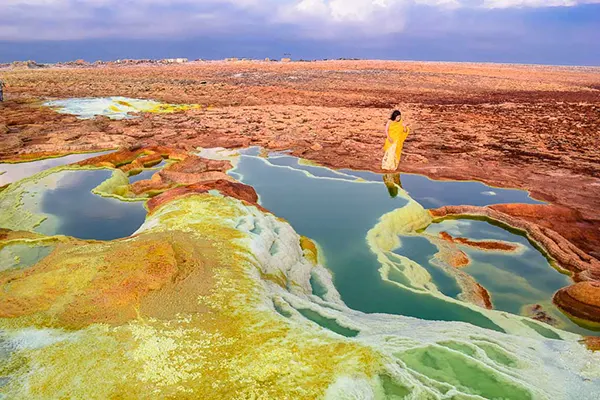
The interaction between volcanic activity and mineral-rich groundwater contributes to the landscape’s colourful salt flats and hydrothermal fields. Water heated by magma dissolves minerals and brings them to the surface, producing vivid formations of sulphur, iron oxide and salt. These bright colours are a natural result of chemical reactions happening in one of the most dynamic geothermal zones in Africa.
Regular seismic shifts reshape the area further, with new vents appearing and old ones collapsing. In recent years, satellite monitoring has recorded subtle ground movements, offering scientists valuable clues about magma migration beneath the crust. Continued observation in 2024 and 2025 helps experts assess long-term geological changes in this unique rift environment.
Volcanic Activity and Hydrothermal Phenomena
Erta Ale remains one of the central features of the Danakil Depression. Its lava lake, active almost continuously for decades, provides researchers with direct insight into the behaviour of basaltic magma. The volcano’s regular but moderate activity allows for controlled scientific observations despite the environmental challenges of the region.
Nearby hydrothermal fields, including those in Dallol, showcase some of the hottest and most acidic springs on Earth. Temperatures may exceed 100°C at certain vents, while acidity levels can approach that of strong industrial chemicals. These conditions create mineral terraces and crystalline structures that draw interest from geologists worldwide.
Data collected in 2025 shows continued geothermal activity beneath Dallol, with chemical analyses revealing slight shifts in sulphur and chloride concentrations. These fluctuations help experts understand the complex underground pathways through which heated fluids travel before reaching the surface.
Climate and Environmental Conditions
The Danakil Depression is often listed among the hottest continuously inhabited regions of the planet. Average annual temperatures frequently rise above 40°C, while peaks in the dry season can exceed 50°C. The intense heat results from a combination of low elevation, minimal vegetation and strong solar radiation throughout the year.
Rainfall in the region is scarce. Most years bring only small and irregular showers that evaporate almost instantly. This dryness contributes to extensive salt plains formed by the slow retreat of ancient lakes. These plains still shift with seasonal moisture variations, though the changes are subtle and difficult to detect without precise instruments.
Climate researchers analysing data from 2023–2025 have been tracking temperature trends in the wider Afar region. While extreme heat remains a long-standing feature, measurements suggest a slight increase in average temperatures over the past decade. These findings contribute to broader studies on climate patterns in the Horn of Africa.
Salt Formations and Mineral Resources
The salt flats of the Danakil Depression cover vast areas shaped by evaporation over thousands of years. Thick salt crusts form geometric patterns, broken by cracks that widen as temperatures fluctuate. These repeated cycles produce layered structures that reveal the area’s long geological history.
For centuries, local Afar communities have worked in the salt fields, cutting large blocks and transporting them across the desert by camel caravans. This labour-intensive practice continues today, though modern tools have eased some of the physical burden. The blocks remain important in regional trade, linking the tradition to present-day markets.
Mineral surveys conducted between 2020 and 2025 show the presence of potassium, magnesium and other valuable resources beneath the salt layers. These findings have encouraged exploratory studies, though environmental experts emphasise cautious approaches to protect the sensitive geological structures.
Cultural and Scientific Significance
The Afar people have adapted to the challenges of the Danakil Depression for generations. Their knowledge of the terrain, weather and natural cycles plays an essential role in daily life. Traditional settlements are built to withstand heat and dryness, using designs that maximise limited shade and airflow.
Scientific expeditions often rely on the expertise of local guides familiar with the region’s shifting landscapes. Their understanding of safe routes across volcanic and salt zones remains crucial, especially given the presence of unstable crust and active vents. Collaboration between researchers and the local population has grown steadily in recent years.
The Danakil Depression also holds value for biological studies. Extreme conditions resemble those found on other planetary bodies, making the area relevant to astrobiology. Microorganisms discovered in the acidic pools of Dallol continue to spark interest, as they survive in environments that were once considered entirely inhospitable. Findings up to 2025 contribute to ongoing research into the limits of life on Earth.
Modern Research and Conservation Efforts
International scientific teams maintain monitoring stations across the depression to track temperature trends, gas emissions and ground deformation. These efforts help create detailed models of volcanic behaviour, improving understanding of the geological systems beneath Afar. The collected data also supports safety assessments for field researchers.
Environmental groups advocate for responsible exploration, highlighting the fragility of hydrothermal formations. Some mineral terraces at Dallol can break under the smallest vibration, making controlled access essential. Conservation guidelines drafted between 2022 and 2025 aim to balance scientific work with the preservation of natural sites.
Ongoing cooperation between Ethiopian authorities, local communities and research organisations is vital for managing future activities in the depression. As interest in its unique features grows, structured policies help ensure that the landscape’s scientific and cultural value remains protected for years to come.
Popular articles
-
 Plitvice Lakes, Croatia: When to Visit for the Best Experience
Plitvice Lakes National Park is one of Croatia’s most recognised …
-
 Salzburg (Austria): Old Town, Fortress and Scenic Panoramas — A Weeken...
Salzburg is one of the most compact historic cities in …
-
 Meteora, Greece: Monasteries, Dress Code and a One-Day Route
Meteora is one of the most extraordinary cultural landscapes in …