

Alhambra, Spain: What to Know Before Visiting the Palace Complex in Granada
The Alhambra in Granada is one of the most carefully preserved examples of Moorish architecture in Europe, attracting millions of visitors each year. Built primarily during the 13th and 14th centuries under the Nasrid dynasty, the complex combines palaces, fortifications, gardens and residential areas into a single historical site. Before planning a visit in 2026, it is worth understanding how access works, what to prioritise inside the complex, and how to avoid common mistakes that can affect your experience.
Planning Your Visit: Tickets, Timing and Practical Details
One of the most important aspects of visiting the Alhambra is securing tickets in advance. Daily visitor numbers are strictly limited, particularly for access to the Nasrid Palaces, which operate on timed entry slots. In 2026, official tickets are typically released several months ahead, and high-demand periods such as spring and autumn often sell out quickly. Buying through the official Patronato de la Alhambra website remains the safest option to avoid inflated resale prices.
Timing your visit can significantly influence how comfortable the experience feels. Early morning slots are usually quieter and offer softer light for photography, while late afternoon visits may be warmer but less crowded in certain areas. Summer temperatures in Granada frequently exceed 35°C, making shaded areas and water breaks essential, whereas winter visits are calmer but come with shorter daylight hours.
Access logistics also matter. The Alhambra sits on a hill above Granada, and visitors can reach it on foot, by taxi, or via public bus routes such as the C30 and C32. Walking up from the city centre takes around 20–30 minutes and can be steep in parts, so comfortable footwear is recommended. Security checks at the entrance require ID matching the ticket, so bringing valid identification is mandatory.
Understanding Entry Rules and Restrictions
The Nasrid Palaces have the strictest entry controls within the complex. Your ticket will display a specific time window, and missing it usually means losing access entirely. Arriving at least 30 minutes early is advisable, especially during busy periods when queues form at the entrance gates.
Photography is permitted in most areas, but the use of tripods, flash, or professional equipment may be restricted without prior permission. In recent years, the site has introduced tighter controls to protect fragile decorative elements, including carved stucco and wooden ceilings that are sensitive to environmental changes.
Large bags and luggage are not allowed inside, although there are lockers available near the entrance. Food is also restricted in certain areas, particularly within the palaces, to preserve the interiors. Visitors should plan breaks in designated zones such as the gardens or nearby cafés outside the main palace structures.
What to See Inside the Alhambra Complex
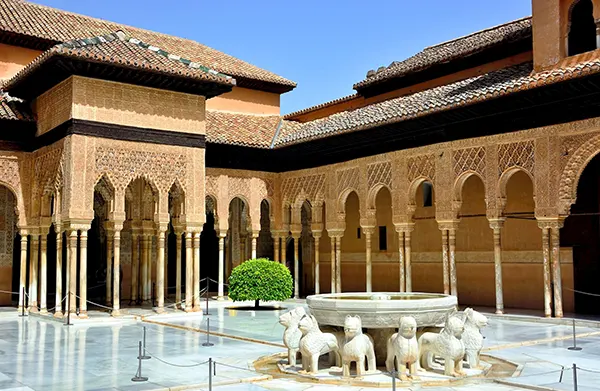
The Alhambra is not a single building but a network of distinct sections, each with its own character. The Nasrid Palaces form the architectural centrepiece, featuring intricate geometric patterns, Arabic calligraphy, and courtyards such as the famous Court of the Lions. These spaces reflect the political and cultural life of the Nasrid rulers in the final centuries of Muslim rule in Spain.
Beyond the palaces, the Alcazaba offers a more defensive perspective on the complex. As the oldest part of the Alhambra, it served as a military fortress. Climbing its towers, particularly the Torre de la Vela, provides wide views over Granada and the surrounding Sierra Nevada mountains, which are especially clear on cooler days.
The Generalife gardens, located slightly uphill from the main complex, were used as a summer residence. They feature water channels, terraces, and landscaped greenery that contrast with the more enclosed palace interiors. In 2026, these gardens remain one of the quieter areas, especially in the early morning or late afternoon.
Hidden Corners and Less Crowded Areas
While most visitors focus on the Nasrid Palaces, there are quieter sections worth including in your route. The Partal gardens, for example, offer reflective pools and smaller pavilions with fewer crowds, making them suitable for a slower pace and detailed observation of architectural features.
The Palace of Charles V, a Renaissance addition within the complex, often receives less attention despite its historical significance. Its circular courtyard contrasts sharply with the Islamic architecture around it, illustrating the transition of power after the Christian Reconquista.
Exploring the perimeter walls and lesser-used pathways can also provide a different perspective on the Alhambra’s scale. These areas reveal how the complex functioned as a self-contained city, with water systems, residential quarters, and defensive structures working together.
Best Strategies for a Comfortable and Efficient Visit
Given the size of the Alhambra, planning your route in advance helps avoid unnecessary backtracking. Most visitors start with the Alcazaba, continue through the Nasrid Palaces at their allocated time, and finish in the Generalife gardens. This sequence follows the natural flow of the site and reduces walking fatigue.
Allowing at least three to four hours is essential for a complete visit. Rushing through the complex often leads to missed details, especially in areas where architectural decoration requires time to appreciate. Audio guides or guided tours can add useful context, particularly regarding symbolism in Islamic art and the historical evolution of the site.
Weather preparation is another key factor. Granada’s climate can be extreme depending on the season, so carrying water, sun protection, or a light jacket is advisable. Surfaces within the complex are uneven in places, including stone paths and steps, so sturdy footwear improves both comfort and safety.
Common Mistakes Visitors Should Avoid
One of the most frequent issues is underestimating the importance of ticket timing. Missing the Nasrid Palace entry slot cannot usually be corrected on the same day, and this is the highlight for many visitors. Setting reminders and arriving early helps prevent this problem.
Another mistake is trying to see everything too quickly. The Alhambra rewards a slower approach, where small details such as tilework, inscriptions, and water features become more noticeable. Allocating enough time reduces stress and improves overall understanding of the site.
Finally, relying on last-minute planning can lead to disappointment. Tickets, transport, and accommodation in Granada are all affected by demand, especially during peak travel seasons. Preparing these elements in advance ensures a smoother visit and allows you to focus on the historical and architectural experience.
Popular articles
-
 The history of the Kurhaus in Baden-Baden – the jewel of casinos...
A few centuries ago, gambling was closely associated with aristocratic …
-
 Île Seguin in Paris in 2026: How a Former Renault Factory Became a New...
Île Seguin is one of the most striking examples of …
-
 Casino Admiral Škofije After Its 2026 Renovation: What to See on the S...
Casino & Hotel Admiral Škofije reopened on 3 April 2026 …